FSAE Firmware Monorepo
Overview
As the Electrical Lead for Olin Electric Motorsports, I recognized that siloing our firmware and hardware designs across dozens of separate repositories was creating massive integration bottlenecks. To solve this, I architected and deployed a unified Monorepo from the ground up. This system serves as the single source of truth for all vehicle firmware, shared C libraries, custom KiCad PCB footprints, and continuous integration testing.
My Role & The Tech Stack
- Role: Systems Architect & Firmware Lead
- Build System: Bazel, OpenOCD, GDB, GNU Make
- Hardware Target: STM32G441 Microcontrollers
- Tooling: Python (Code Generation), YAML, GitHub Actions, Git LFS, KiCad
- Skills: CI/CD Pipelines, Developer Experience (DevEx), Embedded C, Toolchain Architecture
Architectural Pillars & Tooling
1. The Bazel Build System & DevEx
Transitioning to a monorepo requires an incredibly fast and scalable build system, which is why I implemented Bazel.
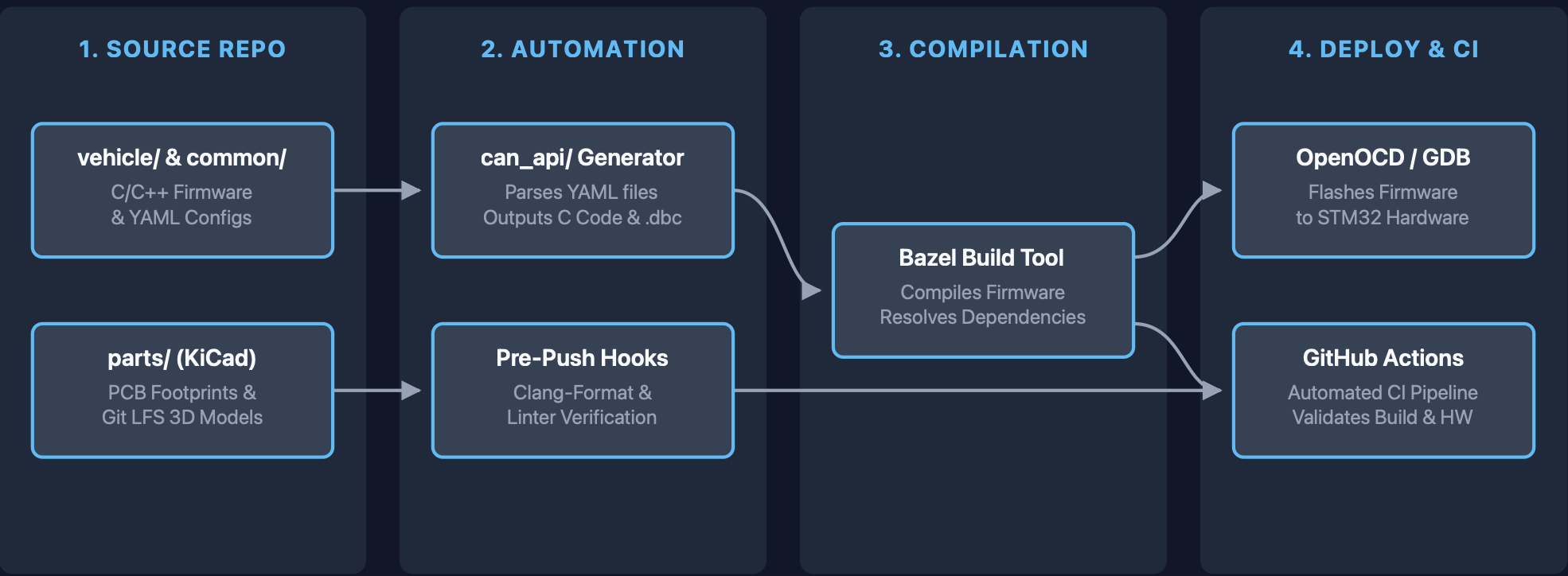
Beyond just compiling code, I wanted to lower the barrier to entry for new team members. I configured the repository to include pre-written linker scripts and integrated OpenOCD and GDB, allowing developers to compile, flash the STM32 hardware, and launch a live debugging session with a single terminal command. I also wrote extensive example directories and an automated script that injects custom Git Hooks to enforce formatting and linting rules locally before a developer is even allowed to push their code.
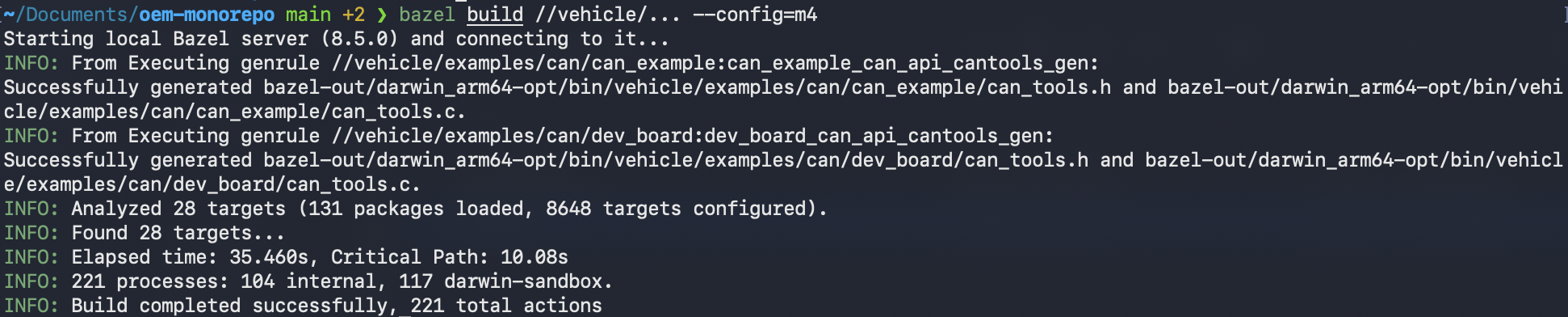 Caption: Bazel succesfully building/compiling all the firmware on the repo
2. Automated CAN Code Generation
A major source of bugs in electric vehicles is mismatched CAN bus configurations between different circuit boards. To eliminate human error, I engineered an automated code-generation pipeline.
Developers simply fill out a lightweight YAML file specifying the CAN messages their specific board needs to send or receive. During the build process, a custom Python script parses these YAML files and automatically generates the C initialization code for the STM32G441. Additionally, it compiles a vehicle-wide master .dbc file, allowing us to seamlessly decode live vehicle traffic using a CAN interpreter.
 Caption: Block Digram of how CAN automation works
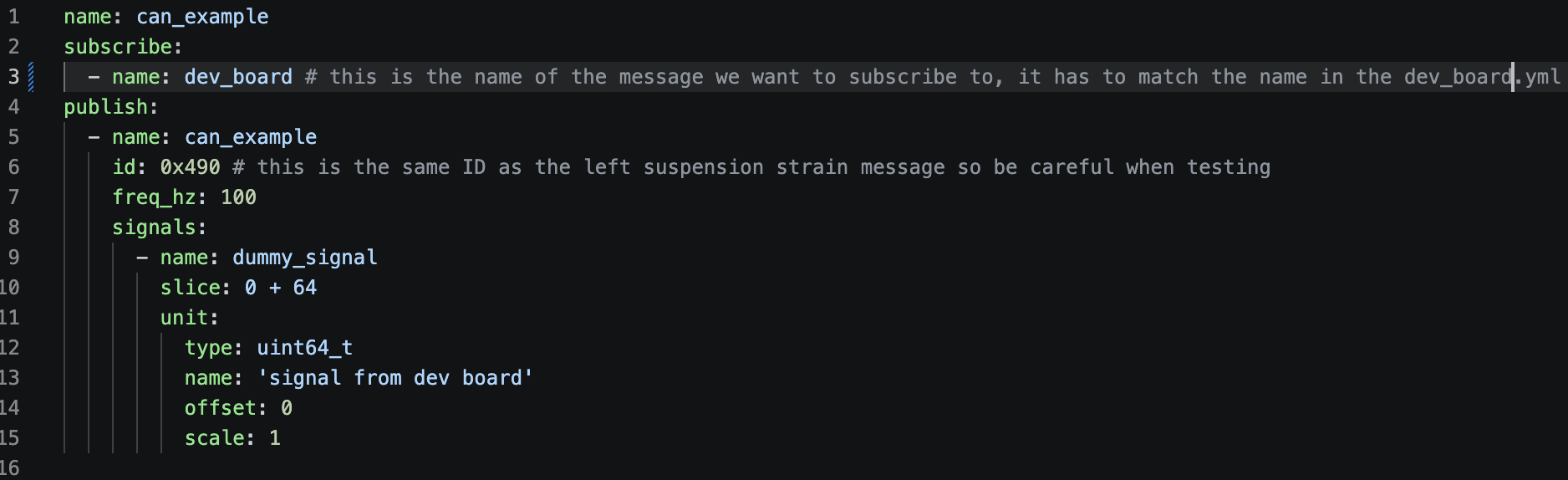 Caption: what the yaml code looks like for developer
3. Unified MCU Abstractions
By standardizing the entire vehicle architecture onto the STM32G441 microcontroller, I was able to write a single, robust hardware abstraction layer (HAL) for the monorepo. I developed shared helper functions for core communication protocols like SPI, I2C, and UART. Instead of rewriting initialization sequences, every sub-team imports the exact same validated core library, drastically reducing development time.
4. Hardware/Firmware CI/CD Pipeline
A monorepo isn’t just for software. I integrated our entire KiCad part library into the repo, utilizing Git LFS (Large File Storage) to efficiently track bulky .step 3D CAD files.
To maintain strict quality control, I implemented GitHub Actions. Before any hardware or firmware pull request can be merged into main, the CI pipeline automatically boots up, verifies that all hardware footprints are imported correctly, and ensures that the firmware compiles flawlessly across every single board on the vehicle.
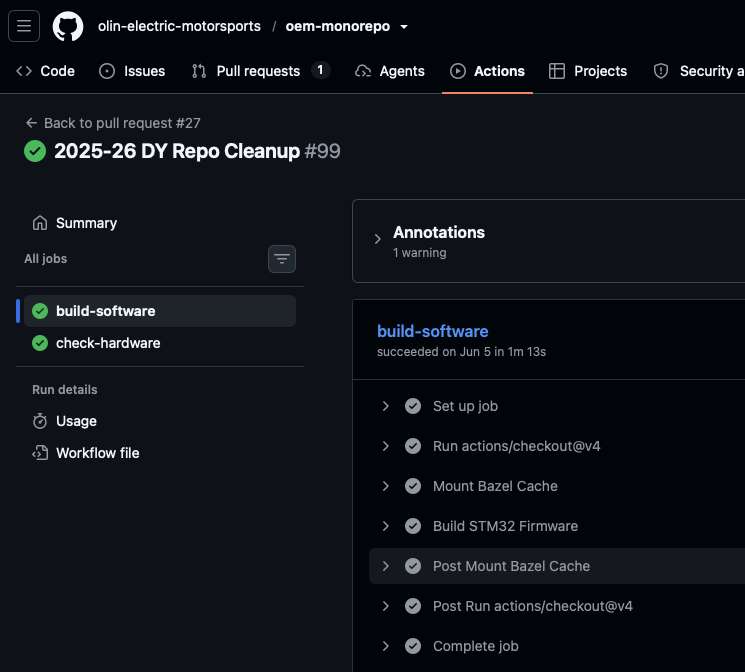 Caption: Checks on a pull request for hardware and software
Outcomes
Architecting this monorepo completely transformed the team’s engineering workflow. By automating the tedious setup processes (like CAN initialization and linker configurations) and enforcing strict PR reviews, our engineers can now focus purely on writing control logic and designing circuits.